

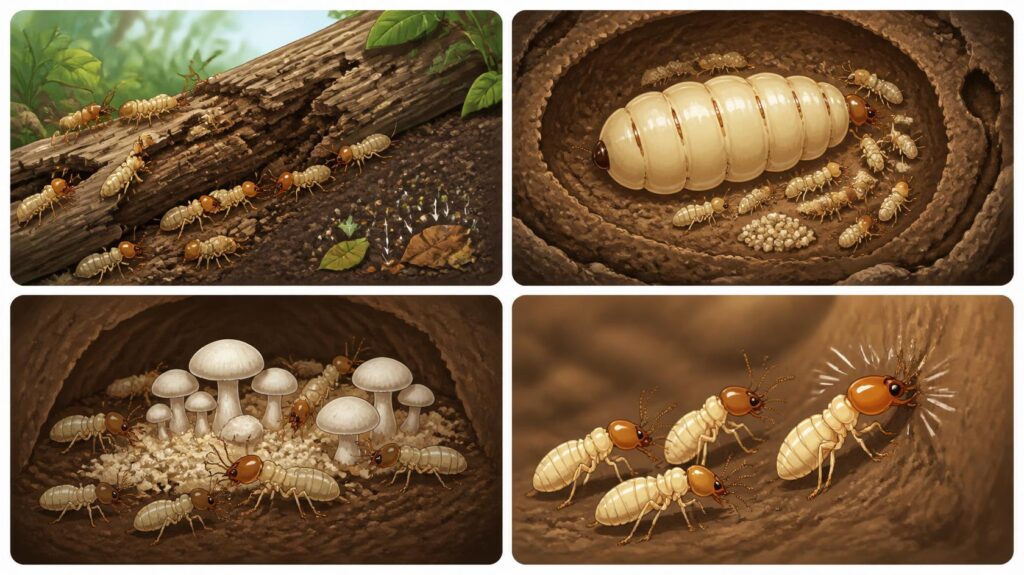
Here are 10 fun facts about termites that have nothing to do with your foundation. Termites usually get mentioned in one context: home damage. But most species never touch a house. They’re decomposers, farmers, and some of the oldest surviving insects on Earth.
1. Termites Are Older Than the Dinosaurs’ Extinction
Termites have been around for more than 100 million years, meaning they were already thriving while dinosaurs still roamed the Earth. When the asteroid struck 66 million years ago and wiped out most dinosaur species, termites survived and continued evolving into the insects we know today.
Fun Fact about termites: There are now over 3000 known species of termites around the world.
2. They’re More Closely Related to Cockroaches Than Ants
People often call termites “white ants,” but that’s actually incorrect. Scientists discovered through DNA research that termites evolved from ancient cockroach ancestors. In fact, one group of wood-eating cockroaches is considered termites’ closest living relative.
So although they behave a bit like ants by living in colonies, they’re actually members of a completely different family tree.
🤔 Curious About Something Else?
If you’re enjoying fun facts about termites, remember that coffee wasn’t “discovered” in the scientific sense, but legend says Ethiopian goat herders first noticed their animals becoming unusually energetic after eating coffee berries.
➡️ Read: 15 Fun Facts About Coffee
3. A Queen Can Live for Decades
Most insects live for only weeks or months, but termite queens are remarkable exceptions. Some species can live 20 to 50 years, spending nearly their entire lives producing eggs for the colony.
That’s one reason colonies can survive for decades if left undisturbed.
4. She Can Lay Thousands of Eggs Every Day
As the colony grows, the queen’s abdomen becomes enormously enlarged—sometimes hundreds of times larger than that of an ordinary termite. In large colonies, she can lay thousands of eggs every single day, ensuring there’s always a new generation of workers, soldiers, and future queens.
It’s one of the most productive reproductive systems in the animal kingdom.
5. Most Termites Never Enter Houses
Although homeowners understandably dislike termites, the vast majority never come near buildings. Most species spend their entire lives breaking down dead logs, fallen branches, and tree stumps in forests.
Without them, forests would slowly become buried beneath layers of dead wood.
6. They’re Nature’s Recycling Experts
Termites can digest cellulose, the tough material that makes up most plant cell walls. Very few animals can do this without help.
Special microbes living inside a termite’s gut break cellulose down into nutrients the insect can actually use. It’s a perfect example of two very different organisms working together.
7. Some Species Actually Farm Mushrooms
Long before humans became farmers, certain African termites had already mastered agriculture. They collect plant material, use it to grow special fungi inside their nests, and then eat the fungus rather than the raw plant matter.
Scientists consider this one of nature’s oldest farming systems.
8. Their Homes Have Natural Air Conditioning
Some termite mounds rise several metres into the air. Inside, an elaborate network of tunnels constantly moves fresh air through the colony.
This natural ventilation helps maintain a remarkably stable temperature, even when the outside air becomes extremely hot or cold. Engineers have even studied termite mounds when designing energy-efficient buildings.
9. The Colony Never Really Sleeps
Individual termites take periods of rest, but the colony itself never shuts down. Workers continue gathering food, soldiers guard entrances, and the queen continues producing eggs around the clock.
It’s like a city that operates 24 hours a day.
10. They Sound the Alarm by Banging Their Heads
When danger approaches, some soldier termites literally bang their heads against the walls of their tunnels. The vibrations travel through the colony and warn other termites that a predator may be nearby.
It’s a surprisingly effective alarm system that doesn’t require sight or sound in the way humans think of communication.
